
Why Manual Production Struggles to Keep Up With Short-Drama Ad Creative
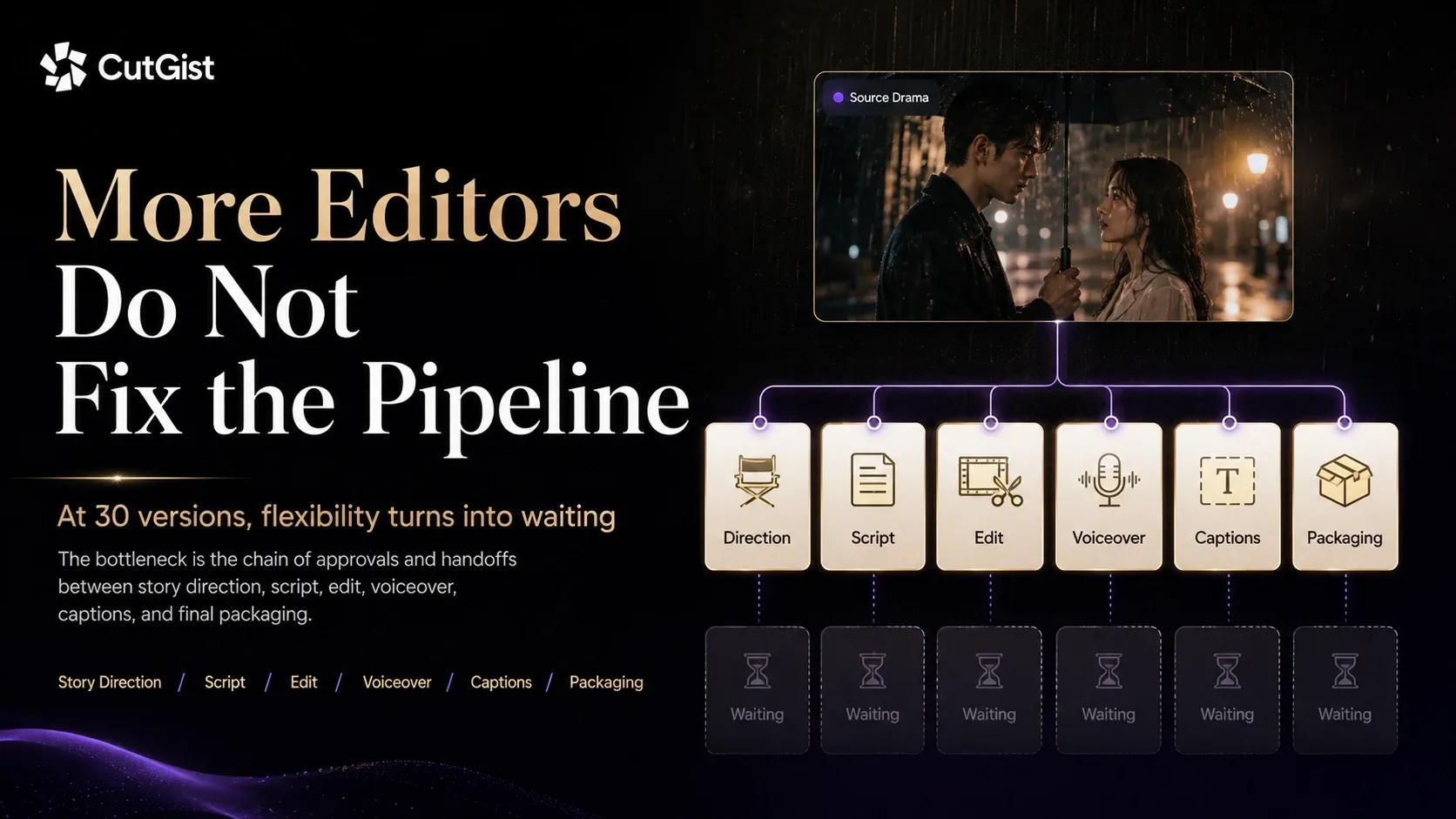
A team producing a few short-drama recap ads can often coordinate informally. As the brief expands to dozens of versions, the dependencies become harder to manage: editors wait for scripts, voiceover waits for final wording, and an earlier revision sends later stages back to work.
Everyone stays busy, yet finished videos do not arrive much faster.
The bottleneck can lie in the production workflow even when each person is working efficiently. At higher volume, repeated waiting, confirmation, and rework take an increasing share of the team's time.
Every handoff adds work as the batch grows
A typical narrated short-drama ad moves through several stages:
Step 1: Planning establishes the creative direction.
Step 2: Writing turns that direction into a narration script.
Step 3: Editing matches the footage to the script.
Step 4: Voiceover and captions complete the presentation.
Step 5: Review and revisions lead to the final video.
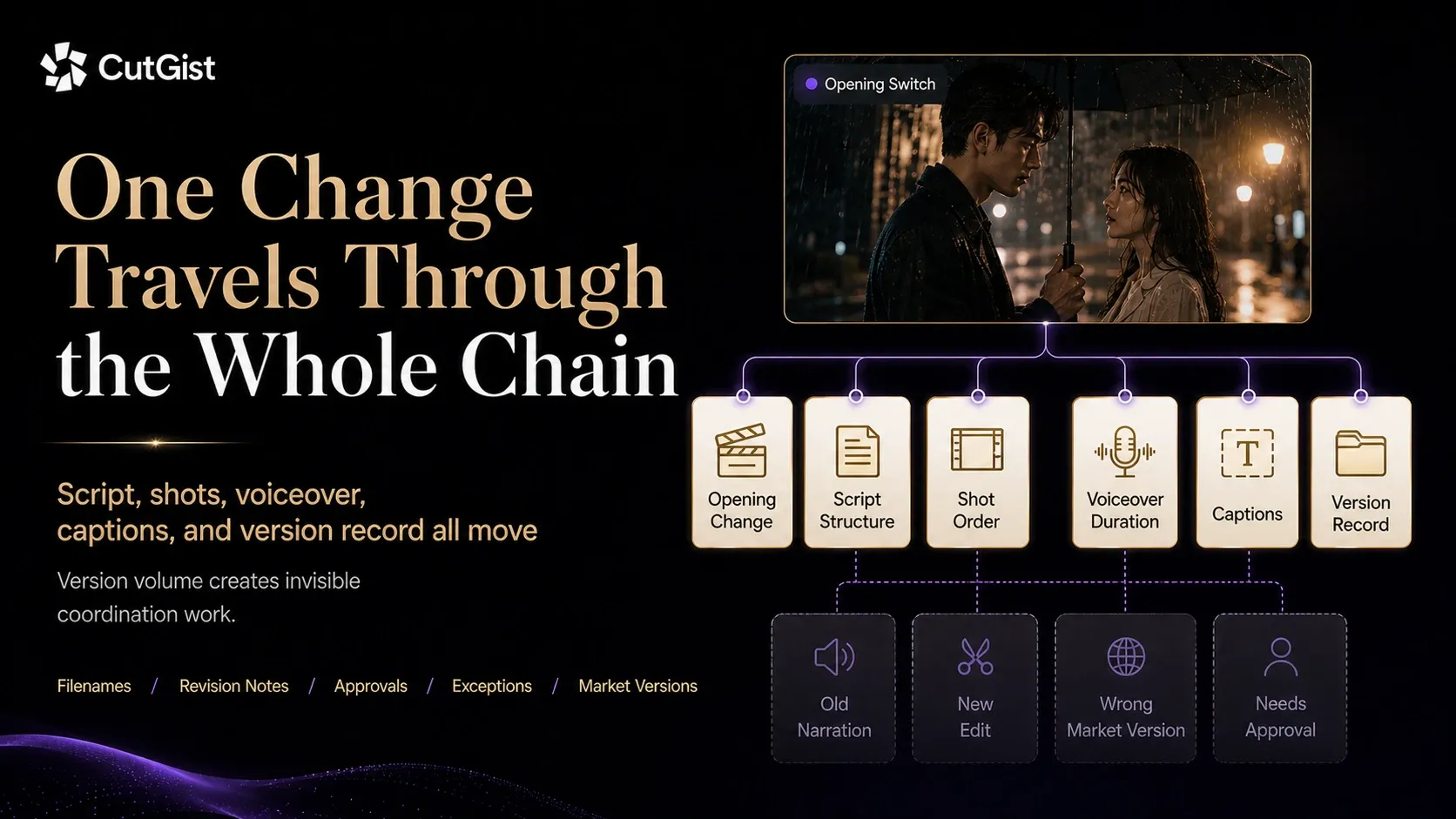
These stages depend on one another. A change to the opening can affect the script, shot sequence, narration, and captions that follow.
For a few ads, a quick conversation may keep everyone aligned. With dozens in progress, the team repeatedly needs to establish which versions are approved, which need changes, whether the current file is the latest, and whether the next stage can begin.
More versions mean more production work and more work coordinating production. The second workload is easy to overlook when planning capacity, but it still occupies the same people who need to finish the videos.
Creative variations multiply dependencies
A batch of ad creatives involves more than duplicating the same video. Different versions may change:
• Opening hook: The first line that draws the viewer into the story.
• Story entry point: The moment or conflict used to introduce the drama.
• Character perspective: Whose experience guides the narration.
• Featured scenes: The dramatic moments selected for the edit.
• Narration pace: How quickly the story and its key turns unfold.
Any of these choices can affect editing, voiceover, and captions. Changing the hook, for example, may require a new opening shot and a different length of narration, with corresponding caption changes.
Two problems grow with the number of versions. First, scripts, audio, and edits must stay matched. A misplaced file can combine an old recording with a new cut. Second, an upstream revision travels through the remaining stages, creating further work each time it is handed over.
The delay often comes from these accumulated interactions. Speeding up one editing action does little to resolve a batch whose scripts, recordings, and cuts keep falling out of step.
More staff cannot remove a dependency
Adding an editor increases editing capacity. Adding a writer can produce scripts faster, and more voiceover capacity can shorten the recording queue. Those changes help the stages they address.
The workflow can still stall between them. An editor needs a usable script. A revised script may require new narration and captions. Additional staff also need time to understand file relationships, current decisions, and progress.
The batch moves faster when work can continue through the whole process with fewer repeated handoffs. Local capacity matters, but so does the continuity between stages. This is the production problem CutGist addresses for teams making short-drama recap ad creatives at scale.
CutGist manages production from drama footage to finished creative
CutGist brings story understanding, key-scene selection, scripting, editing, voiceover, captions, and final output into one production workflow. Teams provide the short drama and their production requirements, allowing the work to proceed without coordinating each stage across separate roles themselves.
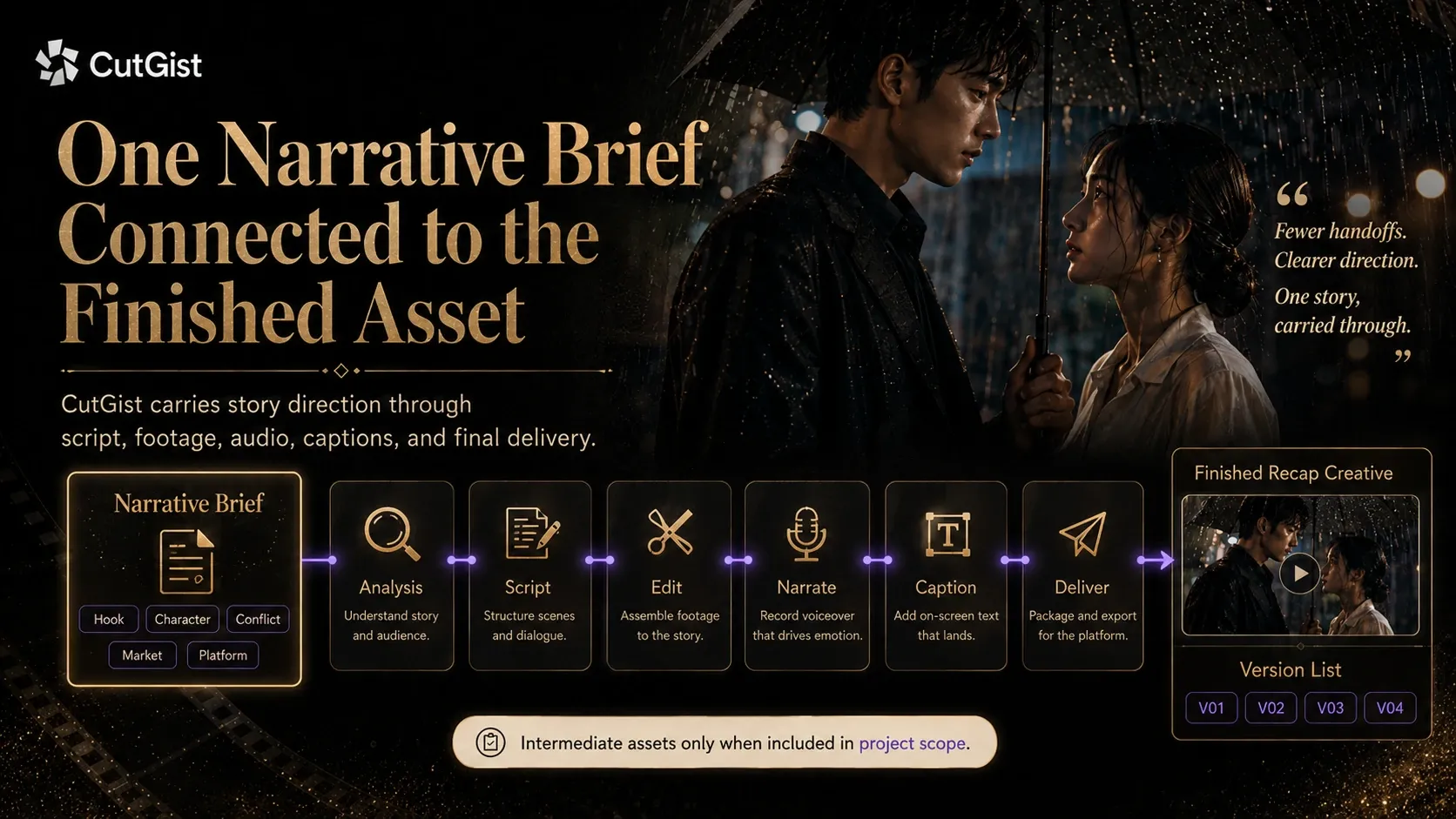
The process moves from understanding the plot and character relationships to selecting a narration angle and writing the script. The footage is then assembled around that script, followed by voiceover, captions, and the finished video.
When one title needs multiple variations, the batch can be built around different story angles. Those directions carry through the production process instead of requiring the client to organize a fresh sequence of handoffs for every version.
The practical benefit is less repeated coordination between the initial material and the finished ads. Teams receive a batch of completed creatives they can review and use in their testing workflow, while CutGist handles the connected production stages.
A growing creative workload needs a repeatable production process
Manual coordination can work well for a small number of ads. Dozens of variations, ongoing testing, and regular replenishment place different demands on the same setup.
A batch workflow needs to keep jobs moving, accommodate additional versions without rebuilding the handoff process, and limit repeated downstream work when changes occur. Those conditions determine whether greater production demand becomes greater output or simply more coordination.
For teams preparing short-drama recap ads in volume, CutGist can handle production from the source material through to finished videos. Provide the drama, genre, and version requirements so the batch can be organized around the actual creative brief. The team can then spend more of its time deciding what to test next, with less time spent chasing each stage of production.
Learn more about CutGist
Visit the website: CutGist official website
Submit your project: Contact us